Work on Ring of Fire Percolates in 2012

A Northern Blog 2nd Entry January 5, 2013

Welcome to A Northern Blog my second entry. In the next several entries I will write about the most significant mining issues facing Northern Ontario, indeed, all of Canada in the first dozen years of the 21st century. How this story unfolds will tell us much about our values, who we are as a people, how we deal with the need to produce wealth, create jobs, protect the interests of our First People’s and operate future mines and rehabilitate the environment once the mining comes to a close.

Today’s blog will set the background and give an overview of what transpired in 2012. Subsequent blogs will examine the progress made by the key mining and mining exploration companies in advancing their plans to open their mines in the Ring of Fire. I will examine the activities of Cliffs Natural Resource, Noront Resources, KWG Mines, Bold Ventures Inc. and MacDonald’s Mining

The articles on developments in the Ring of Fire appears courtesy of Mining Life Magazine. I want to thank publisher Glenn Dredhart for the permission use the article original published in the December, 2012 issue of Mining Life Magazine. For excellent coverage of mining issues in the North and throughout Canada visit the Canadian Mining Portal. Glenn’s company Canadian Trade Ex hosts the largest mining show in the North

http://www.canadianminingexpo.com

Glenn also is in the process of setting up the Canadian Mining Portal which will carry the latest mining information on the internet including e-versions of Mining Life and Exploration News. http://mininglifeonline.net/

Please share your reactions and comments to the articles that appear on A Northern Blog. I value your reaction and feedback

Work on Ring of Fire Percolates in 2012

By Frank Giorno


Preparatory work leading to the development of the vast mineral resources in an area in Northwestern Ontario known as the Ring of Fire continued to percolate in 2012.

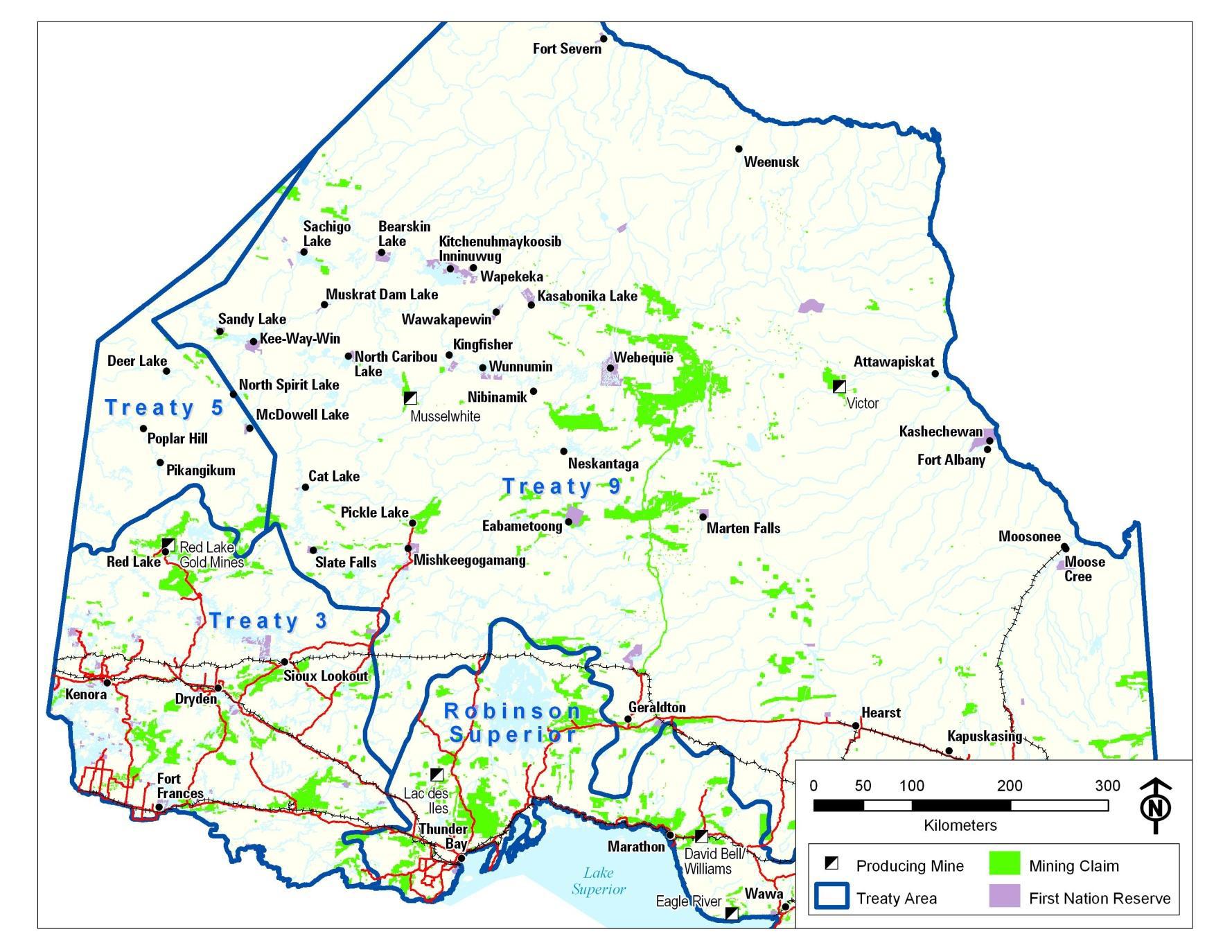
The Ring of Fire is the name given to an area of rich mineral deposits located in the muskeg swamps in the James Bay Lowlands of Northern Ontario approximately 500 km. northeast of Thunder Bay and 70 km. east of the Webequie First Nation. The area contains large deposits of chromite, nickel, copper, gold and other valuable minerals. The area is isolated and can only be accessed by air.

Image

Photo1 – Map companies in the Ring of Free courtesy of Ring of Fire Secretariat, Ministry of Northern Development and Mines

Most of the work being done by the 23 companies with claims in the Ring of Fire mining camp is in the exploration stage, with over $278 million being spent to confirm and further detail the mineral content available for extraction.

Two companies, Cliffs Natural Resources Inc. (Black Thor Property) and Noront Resources Ltd., (Eagle’s Nest Property) are completing their respective joint federal and provincial environmental assessment studies. Before they can begin mining operations, they must obtain government approval of their environmental assessments.

In 2012, Cliffs and Noront both completed their feasibility studies and terms of reference, the first steps towards completing their environmental assessment studies.  To complete their environmental assessment reports, Cliffs and Noront must engage the active participation of the First Nation communities in the area of the proposed mining operation, communities along the proposed transportation corridor which includes an all-weather, north-south road which links to a rail line where trucked ore concentrates would be placed on rail cars for hauling to the proposed chromite refinery that Cliffs wants to build near Sudbury.

A third company, KWG Resources Inc., is undertaking a geotechnical assessment for a potential rail line from the proposed mining sites to refineries and markets.  It also reported on the results of bore hole samples taken on its Big Daddy property.

Two other companies, Bold Ventures and MacDonald Mines, announced the results of their drilling programs which both showed promising results for future mining developments.

In September, a new player arrived on the Ring of Fire Stage — CBC radio reported that a China’s Consul General visited Webequie First Nation and that Sinocan, a Chinese owned company was expected to start drilling near Webequie in October, 2012.  However, a spokesperson said the Ring Secretariat had “no knowledge” of the Chinese visit.

Ontario Government Strongly Supports Mining Development in the Ring of Fire

The Ontario government under Premier Dalton McGuinty is strongly supportive of efforts to develop the Ring and has been active in helping to iron out infrastructure concerns such as the building of an all-weather road from the mining sites that will then connect to a provincial resource road.

The McGuinty government stated in the 2010 and 2011 Throne Speeches that it is fully committed to working with northerners, Aboriginal communities and mining partners to fully realize the Ring’s potential. The McGuinty government wants all companies in the Ring to actively engage and involve First Nation communities whose traditional lands are in the Ring or nearby.

Ring of Fire Secretariat

To help coordinate the activities of the mining companies and address the concerns of the First Nations, McGuinty created the Ring of Fire Secretariat. The Secretariat works with all levels of government, industry and Aboriginal peoples to encourage responsible and sustainable economic development in the region.
Image

Photo 2 – Map First Nations near the Ring of Fire- Courtesy of Ring of Fire Secretariat, Ministry of Northern Development and Mining

Dr. Christine Kaszyicki was appointed as the Assistant Deputy Minister for Ring coordination in 2010. In this role, Dr. Kaszyicki works to ensure a collective effort is undertaken to advance economic development in this promising area.

Memorandum of Understanding with Marten Falls First Nation


In September, the province signed a Memorandum of Understanding (MOU) with Marten Falls First Nation pledging to work together to address employment, economic development and environmental impacts. The MOU is in keeping with the McGuinty Government’s commitment to strengthening First Nations ‘communities while supporting a thriving mining sector. This approach is part of the McGuinty Government’s plan to create jobs for Ontarians, create opportunities for First Nations’ communities and strengthen the Ontario economy.

 First Nations Concerned About Lack of Involvement and Lack of Benefits

Meanwhile, some First Nations in the area are concerned about the lack of benefits and environmental and social impacts from mining on their communities. They continue to press their demands about the need to be consulted prior to development of any mines.  Over the summer of 2012, Six First Nations in the Matawa First Nations council threatened to issue eviction notices to 20 mining companies currently conducting explorations in the Ring, or, as in the case of Cliffs and Noront, preparing their EA.

The six are, Aroland, Nibinamik, Neskantaga, Constance Lake, Ginoogaming and Long Lake #58. The Assembly of First Nations supported the call to issue the eviction orders and so did the Nishnawbe Aski Nation.

However, Marten falls Chief Eli Moonias did not support the call for evictions, saying his community had been adequately consulted.

Judicial Review

A decision is still pending on the judicial review request filed by the Matawa First Nation Council (MFNC). It filed the judicial review on Nov. 7, 2011, calling on the federal government to implement a Joint Review Panel – the most comprehensive form of environmental assessment (EA) – for the Ring.  MFNC claims that an EA limits the opportunity for First Nation involvement in the process.  It is calling for a Joint Review hearing that would allow for greater participation for Matawa First Nations.
Historic Hollinger Mine Project Gets Ready To Re-Open in Timmins as an Open Pit Gold Mine Early in 2013

 Image By Frank Giorno

 Welcome to the first Northern Blog. My mission is to write about Northern Ontario issues. My mission is to present clearly written, well researched articles that present factual information about key Northern Issues.  That means that many of my articles will deal with extractive industries such as mining or forestry and pulp and paper. Transportation and energy issues are also major factors in living in the North as are the conditions of our First Nations communities and their relationship to Northern Development and their traditional cultural values.

 From time to time I will cover Northern cultural, literature, music, social, sports and technology.   I encourage you as my reader to engage in conversation and provide me with feedback on what I have written.

 The first article concerns a controversial proposal by Porcupine Gold Mines, a subsidiary of Goldcorp to re-open gold mining operation at the historic Hollinger site which has been closed to mining since the late 1980s. The PGM’s proposal covers both the short term development of an open pit gold mine and a long term closure plan for the site. The benefits of re-opening the Hollinger Site to mining include job creation and secondary spinoffs to local mining servicing industry, plus the creation of recreational lands after closure.

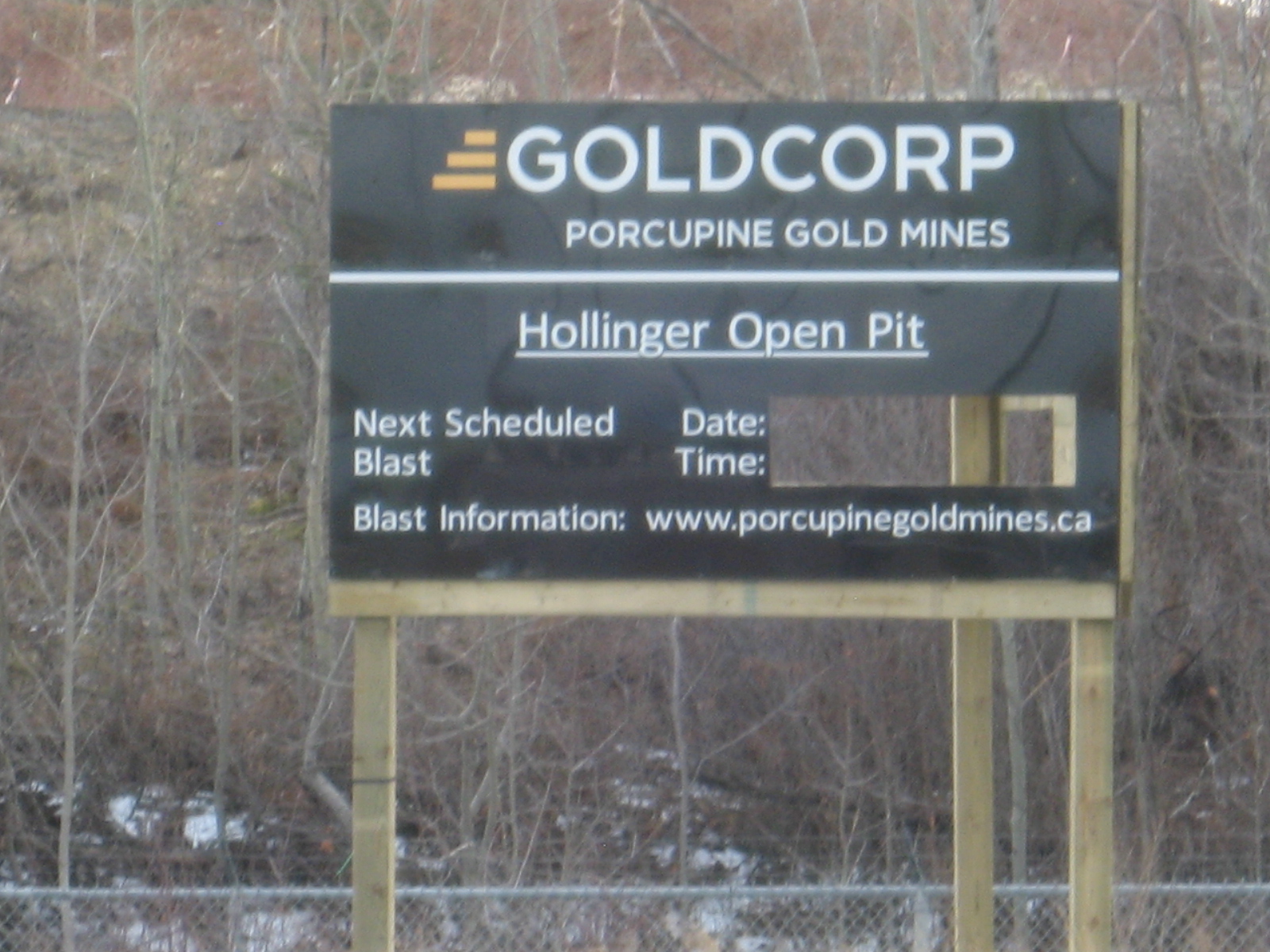
 Large signpost notifying residents and businesses of scheduled blasting times have already been placed by PGM at strategic locations around the mining site.  A firm start date for blasting and mining operations has not been established by PGM, but it is expected to be very soon.

 PGM’s proposal received unanimous support from Timmins Council and is backed by the majority of Timmins residents. There is however concern expressed by residents who live or have business on the periphery of the Hollinger site. The concerns are mostly over noise, vibration and dust issues and ground subsidence which could if it occur lead to major structural damage to nearby homes, one multi-story apartment building and nearby stores.PGM has committed itself  to ensuring that impacts will be mitigated by the creation of an environmental berm and mining practices that will consider the residents’ concerns.

The operation of a mining operation so close to an urban setting is not new. A couple of years ago Osisko Mines physically moved about 250 residents from Malartic, Quebec to mine gold that lay in the ground below the houses. A new open pit was built on land that not been mined before. In Timmins the Hollinger Mine has been in the area  since 1909 and the housing grew around the site over the last 100 years with an apartment building, shopping centres, the Shania Twain Centre, an Extendicare facility and trailer park built after the apparent closure of the mine in the 1980s.

 However in mining centres do mines ever close? Given the high level of exploratory activities around old mining sites in the North and other parts of Canada the answer would be no.

 The article on the re-opening of the Hollinger Site to mining appears courtesy of Mining Life Magazine. I want to thank publisher Glenn Dredhart for the permission use the article original published in the December, 2012 issue of Mining Life Magazine. For excellent coverage of mining issues in the North and throughout Canada visit the Canadian Mining Portal. Glenn’s company Canadian Trade Ex hosts the largest mining show in the North

http://www.canadianminingexpo.com

 Glenn also is in the process of setting up the Canadian Mining Portal which will carry the latest mining information on the internet including e-versions of Mining Life and Exploration News.  http://mininglifeonline.net/

 Hollinger Mine Project Gets Unanimous Approval to Proceed from

 Timmins Council.

 By Frank Giorno


Porcupine Gold Mines (PGM), a subsidiary of Goldcorp Corporation, received unanimous support from Timmins City Council in November for re-opening mining operations at the  Hollinger Mine site just east of downtown Timmins, ultimately rehabilitating the site and returning it to public use after it closes.


Council’s vote accepted the Site Plan Control Agreement with PGM as the outline governing how  the Hollinger Open Pit mine operates and how it would mitigate the concerns of nearby residents and businesses.


In summarizing the importance accepting of the PGM’s plans Mayor Tom Laughren said:

“I am a big supporter of this project. This council has done its due diligence. We have had

32 engineering reports, 40 plus public meetings, countless emails, third party reviews, legal and insurance opinions, five council meetings and the input of the Hollinger Public Advisory Committee.


“Goldcorp is one of the few companies I want to walk down this process with. I want to walk down and finish this project. It’s something this community will have and be proud of,” Laughren concluded.


Councillor Pat Bamford pointed to critical economic benefits that will be generated for Timmins.

“There is an economic momentum that comes from spending half a billion dollars over eight years and with a multiplier effect of three, four or even 10 times, Timmins will receive up to $5 Billion of economic momentum,” Councillor Bamford said.


 “I can’t help but believe that with the economic momentum from the project that there will be a positive effect on property values in Timmins including those on the periphery of the mine site,” Bamford explained addressing the concern residents had over possible loss of property value.


Council members also were relieved that PGM’s will provide a $10 million letter of credit to protect the city from potential lawsuits. Beyond that PGM will remain liable for claims arising from the mining related issues once the site is closed.


Councillor Noella Rinaldo who supported PGM’s proposal acknowledged the concerns of some residents, but believed that the Best Management Plan contained in the Site Plan Control Agreement addressed their concerns. Councillor Rinaldo encouraged PGM to improve their communications with the community.


“It is only fitting that we witness this historic mine being transformed into a modern working open pit mine – what a way to show the world that Timmins is a demonstrated leader in the mining field,”  enthused Councillor Andrew Marks.


Now that  PGM has received Timmins council support, the next step before it can open the mine is to obtain certificates of approval from the Ministry of the Environment for air quality and water taking.


Marc Lauzier’s Impassioned Presentation to Council

Image

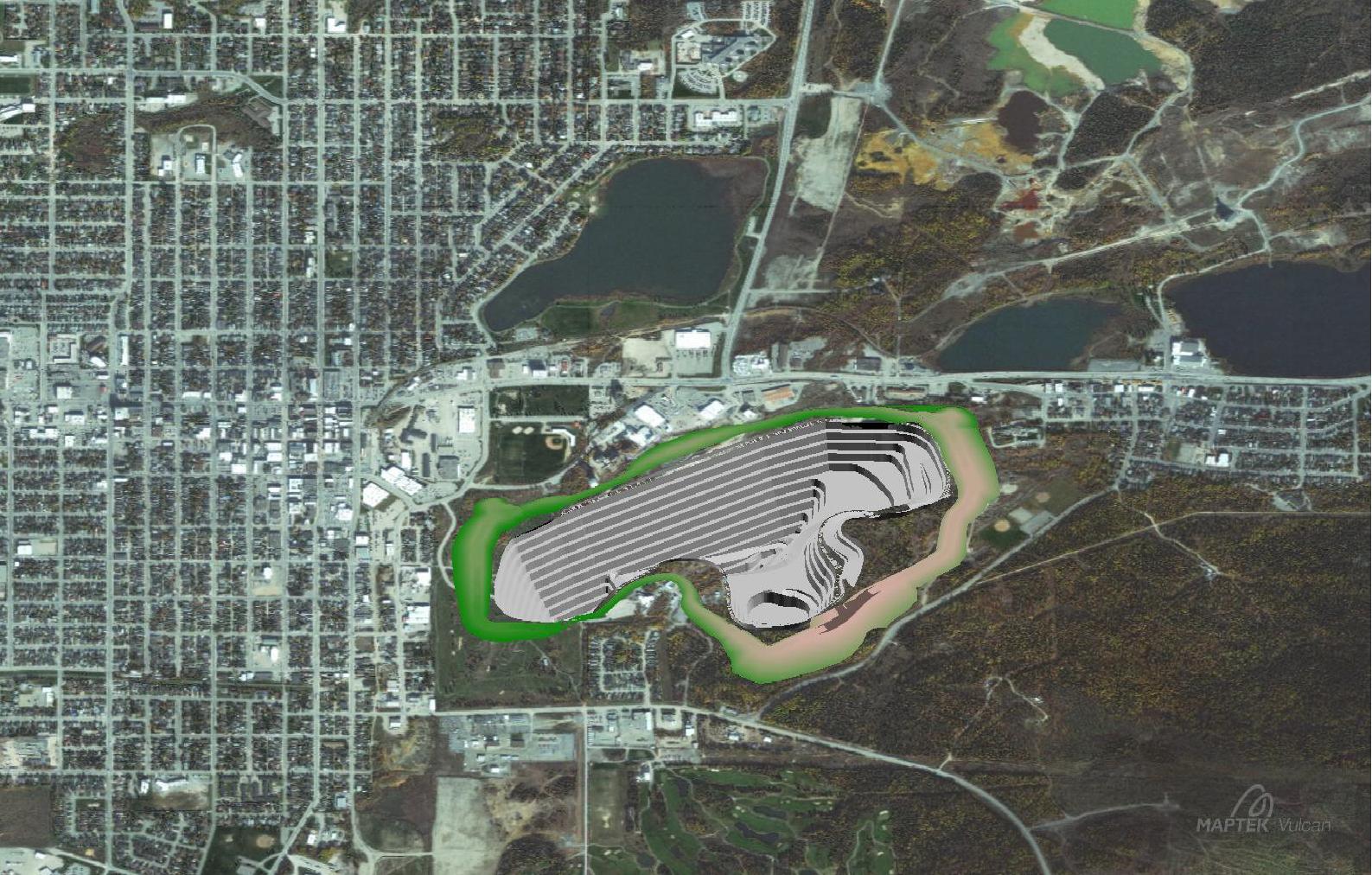
Proposed Hollinger Open Pit Gold Mine -Courtesy of PGM

A week prior to Council’s vote of  approval of the site control plan agreement, Marc Lauzier, general manager of operations for PGM provided an impassioned presentation to council detailing the ways PGM benefits Timmins and addressing questions and concerns that have been swirling around the proposal since it was officially presented to council.


“Without mining there would be no Timmins, where would Timmins be without mining?” Lauzier said.

 Since 1910, over 19.5 million ounces of gold have been mined at the Hollinger Mine which stopped production in 1968, though some surface mining did take place into the early 1980s. The primary goal of PGM’s proposal is to restore the Hollinger site. The renewed gold mining was the way PGM will pay for the restoration of the site Lauzier said.


Lauzier responded to concerns raised about the impact of the project on property values by saying that prices may drop for a short period, but will in the long term increase because the eyesore of the existing unsafe Hollinger site would be replaced by a safe, reclaimed property that would be turned over to the city for public use.


Lauzier said PGM is opened to all reasonable proposals for the after use of the Hollinger property if the proposed public park is not wanted by Timmins. Some concern had been voiced that the maintenance of the park would put a financial burden on the City.


PGM would not guaranty property values Lauzier emphasized. No other mining company in Timmins has been asked to do so as there are too many variables. Lauzier pointed to the economic benefits of 130 jobs created by the project and the additional jobs created by local companies providing services to PGM.


The ore mined from the Hollinger site was needed to keep the Dome Mill operational Lauzier told council members. “Without the ore from Hollinger open pit the consequences would be drastic,” Lauzier said.


Lauzier also said that other mining companies are watching the outcome of PGM’s request to council.  “Other companies know that PGM has spent $25 million to rehabilitate the Hollinger site with the understanding that Timmins was open for business,” he said. “If our proposal is turned down what message would be sent to other companies involved with mining in Timmins


Timmins Regional Economic Outlook Presentation

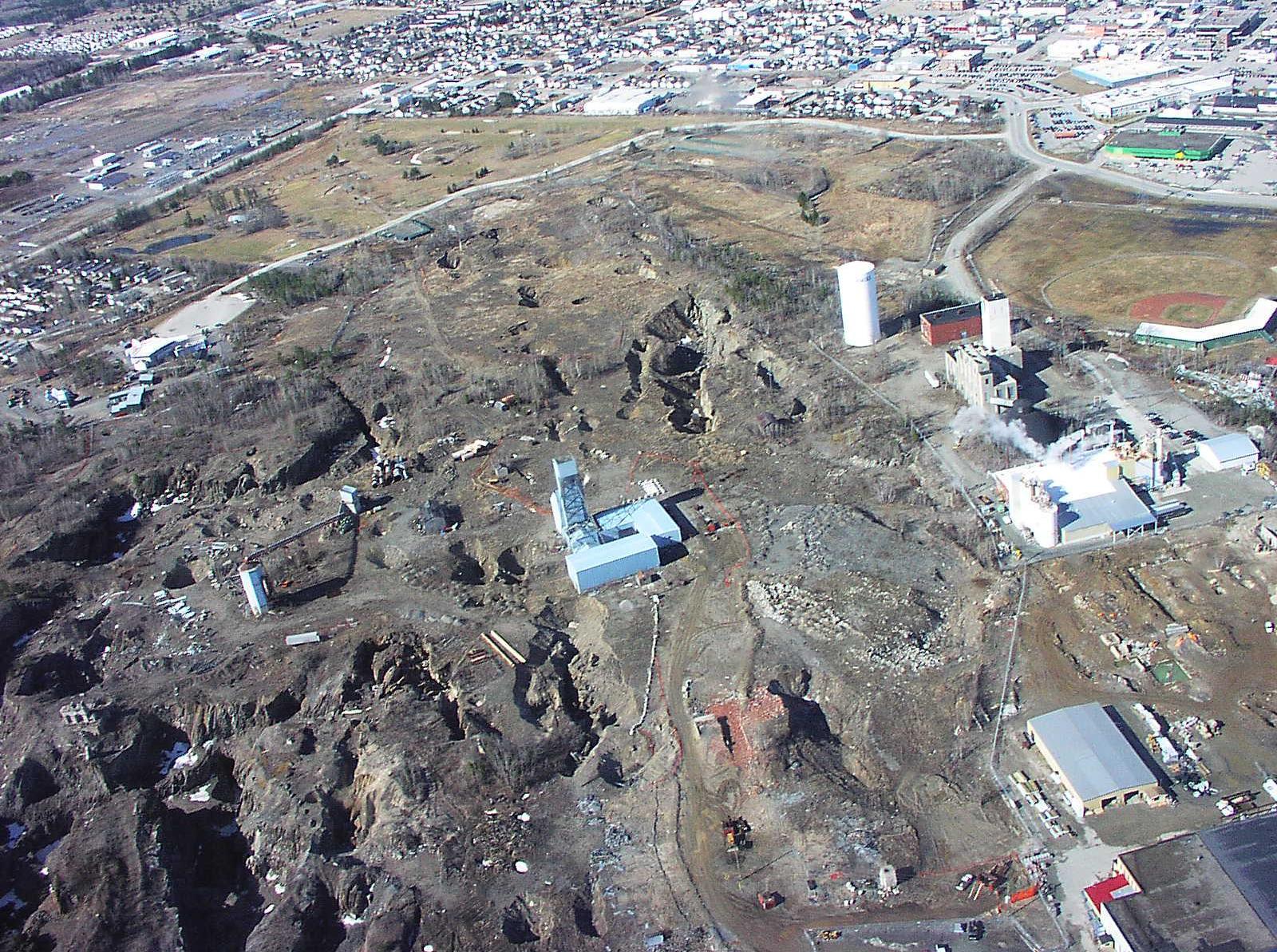
 ImageHollinger prior to being mined and remediated- Courtesy of PGM

Paul Miller, Goldcorp’s Manager of Surface Operations earlier explained the benefits of the company’s plans to mine gold from an open pit mine to be built on the Hollinger site in downtown Timmins at the Timmins Regional Economic Outlook Conference October 15, 2012.


The Hollinger property currently consists of a number of old mined pits and sinkholes. Miller described the current state of old Hollinger mine property as over 250 acres that are “unsafe, unusable – a site with environmental problems, that we will return to a usable site”.  Miller said that PGM is committed to reclaiming the Hollinger site and rehabilitating it for the community as they have down over the years on other sites like the McIntyre Property by Highway 655 which today has  been re-vegetated withwalking trails for the public to use.

 Economic Benefits

  PGM plans to operate an open pit gold mine for eight years.  The mine will employ 180 people and create 130 jobs. The extraction of ore and the development of gold concentrate from the Hollinger site will also add 10 additional years to PGM’s overall operations and sustain 250 jobs over that period.


According to Miller, the direct mining cost associated with the property is $565 million excluding the costs of milling over the life of the open pit mine. Capital expenditures are estimated to be $87 million.


Addressing Environmental Concerns

 The Hollinger Mine property is situated in downtown Timmins, east of Brunette Ave., south of Algonquin Blvd. north of Shania Twain Dr.  and west of Hollinger Road in Schumacher. It is adjacent to a public park and commercial sites, the Senator Place Apartments, a nine story apartment building and residential areas including a trailer park.


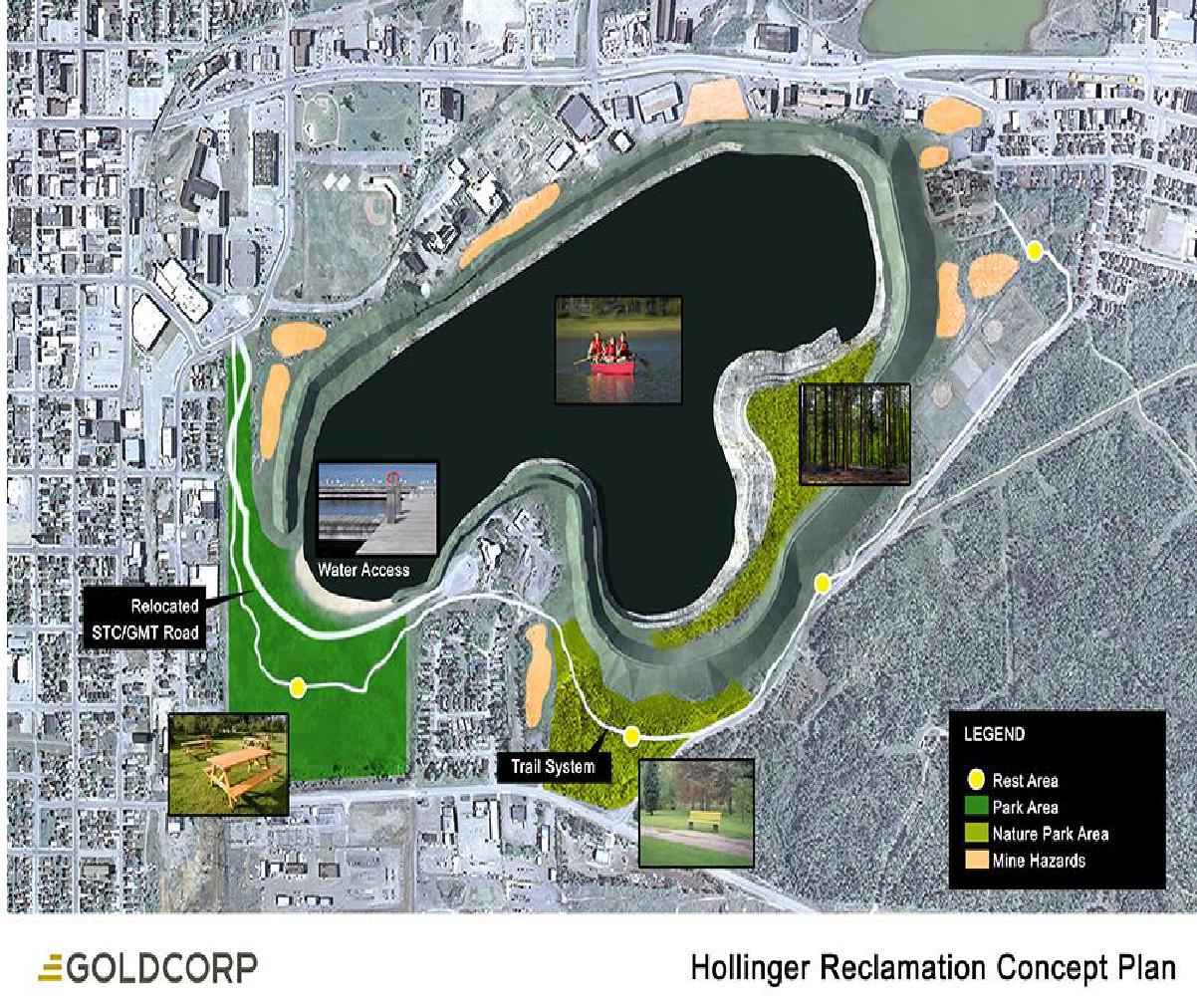
Miller said that PGM will use the most environmental sound methods for mining the Hollinger site to ensure reduced noise, dust and vibrations. Miller described how PGM will meet these concerns by creating a 20 – 25 metre berm with gradual slopes to control dust and noise during construction and operation of the open pit mine. The berm will be constructed of vegetated earth or engineered walls where space is restricted.

Image 

Mining will start at the point farthest from the community and will move north and west, to minimize impact on the community. An estimated 4.4 million tonnes of soil and rock will be removed from the creation of the open pit mine and used to build the berm. The berm itself will take 6.1 million tonnes to construct.

  PGM will also set up noise; dust and vibration monitoring equipment to measure levels and respond quickly to increased levels that may impact on community members. The monitoring equipment will detect when noise, dust and vibration levels exceed acceptable limits.

PGM will use mobile and fixed monitoring stations to help respond quickly to public concerns and complaints about impacts from the Hollinger site. The environmental monitoring will be conducted by a third party to ensure objectivity and confidence in the results. Fixed monitoring stations will be set up onsite and one will be located in Gold Centre, in Schumacher. Real time monitoring results will be available on PGM’s website.


The concerns about increased heavy truck traffic from the mine to PGM’s milling facility at its Dome site has been addressed by the construction of overpasses over Vipond Rd. and Gold Mine Rd. Trucks will make the trip to the milling facility on a dedicated 5 km road between the mine and the Dome Mill and avoid routes used by the public.


As for dewatering of the site, PGM plans to pump water from the Hollinger site to a treatment facility now in place at the McIntyre mine. The treated mine water will be released into Little Pearl Lake.


A particular concern expressed by the owner of the Senator Apartments, located on Algonquin Blvd., north of the Hollinger property has to do with the plans to pump groundwater.

 Bill Hughes the owner of the Senator Place Apartments expressed concerned that vibrations and subsidence will create a hazardous situation that could result in structural damage to apartment building caused by sinking or shifting of ground due to the pumping out of groundwater to keep water out so mining can occur.


Miller said monitoring will be the key to implementing PMG’s environmental protection plan. Monitoring results will trigger an investigation of the source of the problem and determine if there have been any negative impacts. Measures will be taken to mitigate the problem.  


Community Engagement

 “This project is as much about dealing and engaging with the community and mining responsibly in the community as it is about the technical challenges that come with mining,” Miller said


Miller said public consultation that has been ongoing since 2007 when a public advisory committee was established. More recently, a series of presentations about the Hollinger Project, during which the members of the community had an opportunity to express their concerns about the proposal, took place in the summer of 2012. As well, the Hollinger Community Information Centre was reopened in the summer of 2012 and a community liaison officer was appointed to help the public communicate its concerns and to help provide information to the public.


Members of the public can access an interactive website to read about the plans for the Hollinger Property, write their concerns and provide feedback on the project.   http://www.porcupinegoldmines.ca/en/ouroperations/hollinger.asp


Closure and Reclamation

 Once the mining at the Hollinger Property is complete PMG will turn the area into parkland with walking trails. The open pit mine will flood and turn into a lake. Water in the lake is expected to meet provincial standards and be used for recreational purposes.